Why a strengths-based approach to psychological safety works best

Why a strengths-based approach to psychological safety works best

Blogs and Stories

Why a strengths-based approach to psychological safety works best

meeting

 One of the challenges with the new positive duty to eliminate or reduce psychosocial hazards  is that people don’t seem to appreciate that the duty isn’t new – just the word “positive”. Plus the regulators’ approach isn’t new – it is the same risk management model that has been used for decades, just mostly on physical hazard control. Will that work? Can you effectively execute a positive duty with a deficit mindset? We don’t think so. So we decided to ask Chat GPT and here is what we got back.

Why a Strengths-Based Approach Delivers Better Outcomes in Managing Psychosocial Hazards at Work

Across workplaces, the growing focus on managing psychosocial hazards—those factors in work design, management, and environment that may harm mental health—has led many organisations to rethink how they create safe and thriving cultures. Traditionally, efforts to minimise these hazards have centred on identifying risks, rectifying deficits, and preventing harm. While this compliance-based approach is important, it can often feel reactive and deficit-focused, overlooking what makes individuals and teams flourish.

A strengths-based approach offers a more positive and sustainable path forward—one that not only reduces psychosocial risks but also enhances engagement, performance, and wellbeing for both employers and employees.

From Deficit-Focused to Strengths-Driven

The conventional method of addressing psychosocial hazards focuses on what’s wrong: excessive workload, poor leadership, low role clarity, or workplace conflict. While identifying and mitigating these risks is essential, an exclusive focus on problems can inadvertently reinforce a culture of blame or avoidance.

In contrast, a strengths-based approach begins with what’s working well—the inherent capacities, talents, and positive attributes of people and teams. This perspective doesn’t ignore risk; rather, it reframes it. When organisations help employees understand and apply their unique strengths, they build psychological resources such as resilience, optimism, and purpose—powerful buffers against psychosocial harm.

Building Psychosocial Safety Through Strengths

Workplaces that intentionally recognise and develop individual and team strengths create the conditions for psychological safety and wellbeing. Here’s how:

  • Enhancing control and autonomy: When people use their strengths, they experience greater self-efficacy and control over their work—key factors in reducing stress and burnout.

  • Fostering positive relationships: Strengths-based cultures encourage appreciation, collaboration, and respect for diversity of talent, reducing interpersonal conflict and social isolation.

  • Clarifying role purpose: Helping employees align their strengths with organisational goals clarifies expectations and meaning, which reduces role ambiguity—a known psychosocial risk.

  • Encouraging constructive feedback: Strengths conversations shift the focus from criticism to growth, supporting learning without fear of judgement.

Better Outcomes for Employers and Employees

For employers, the benefits are tangible. Research consistently shows that strengths-based organisations report higher engagement, productivity, and retention, along with lower absenteeism and turnover. These outcomes directly reduce the costs associated with psychosocial hazards, such as stress-related leave and workplace disputes.

For employees, the experience is transformational. They feel seen for what they contribute best, leading to a stronger sense of belonging and satisfaction. As workers become more confident and energised, they are better able to cope with challenges, communicate needs, and support one another—further reducing psychosocial risk exposure.

Embedding Strengths into Psychosocial Risk Management

Integrating a strengths-based approach doesn’t mean ignoring compliance obligations under models like Safe Work Australia’s Code of Practice. Rather, it complements them by embedding proactive wellbeing strategies into the fabric of work. This might include:

  • Incorporating strengths assessments (e.g. VIA Character Strengths or CliftonStrengths) into onboarding and development;

  • Training leaders to hold strengths-focused conversations that build trust and motivation;

  • Designing roles and workflows that leverage team strengths to distribute demands more effectively.

Ultimately, managing psychosocial hazards is not just about avoiding harm—it’s about creating thriving workplaces. A strengths-based approach transforms compliance into culture, prevention into empowerment, and obligation into opportunity.

When people work from their strengths, they don’t just survive—they flourish. And when they flourish, so do the organisations around them.

CONCLUSION

We agree with Chat GPT and what this says aligns exactly with our own beliefs and why we created PosWork in the first place.

Note: we don’t have a problem with using AI to fast track tasks and make better use of our time but we also believe we should acknowledge that and not claim creative credit when we do use AI.

We are going to be talking about our Strengths-Based Approach to managing psychosocial hazards at work at our upcoming webinar  on

Monday 10 November 2025 11:00 AM – Tuesday 11 November 2025 12:00 PM (UTC+11)

Bookings at https://www.trybooking.com/DGREZ

CONTACT US

PosWork

A Division of Ridgeline Human Resources Pty Ltd
ABN : 24 091 644 094

info@poswork.com.au

0438 533 311

LET'S HAVE A CHAT

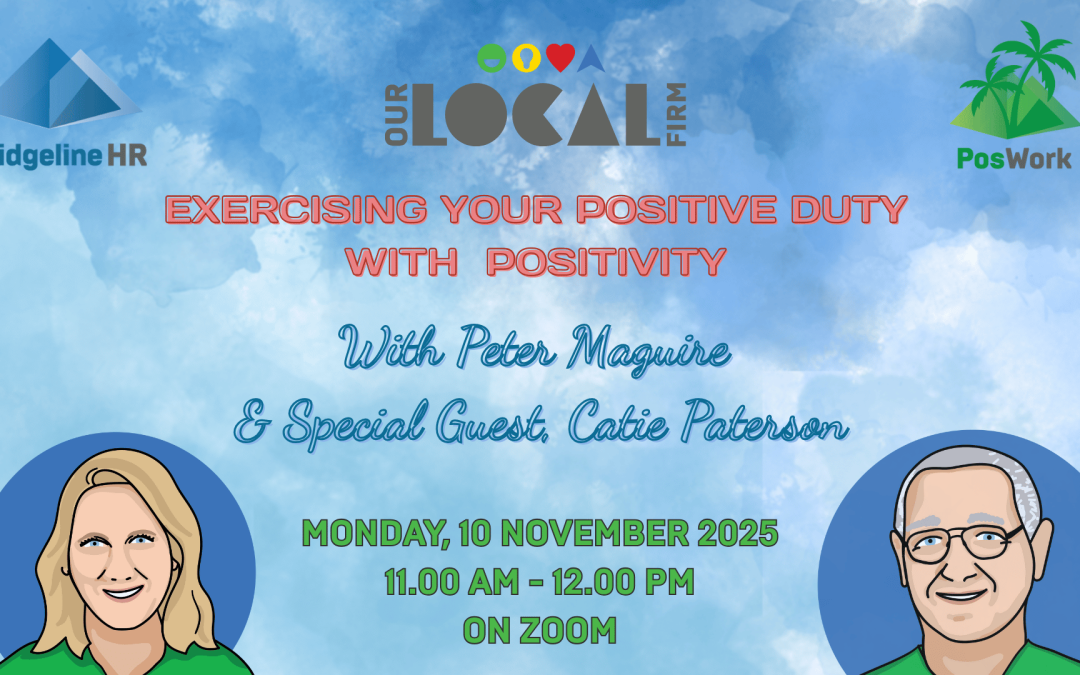
Webinar: Exercising Your Positive Duty With Positivity

Webinar: Exercising Your Positive Duty With Positivity

Blogs and Stories

Webinar: Exercising Your Positive Duty With Positivity

meeting

ABOUT

From 1 December 2025, all Victorian businesses have a new positive duty to eliminate or reduce psychosocial hazards and that involves a lot more than just doing a risk assessment and updating your policies. It also provides a great opportunity for business leaders and HR and WHS professionals to generate real and lasting cultural change with strong employee engagement and psychological safety. Peter Maguire, Practice Leader at Ridgeline HR and PosWork will be discussing this with Catie Paterson from Blue Kite Consulting. They share decades of experience in the HR field and are experts in workplace relations and related compliance as well as in positive psychology based workplace cultures and change management. When you blend all of that together, you’ll get much more than the same old risk management spiel on psychosocial hazards and they’ll teach you how to address the positive duty with positivity using a strengths-based approach with some practical exercises to boot.

DATE

Monday 10 November 2025 11:00 AM – Tuesday 11 November 2025 12:00 PM (UTC+11)

Bookings at https://www.trybooking.com/DGREZ

CONTACT US

PosWork

A Division of Ridgeline Human Resources Pty Ltd
ABN : 24 091 644 094

info@poswork.com.au

0438 533 311

LET'S HAVE A CHAT

Celebrate International Fun At Work Day

Celebrate International Fun At Work Day

Celebrate International Fun At Work Day

meeting

 April 1 is “International Fun At Work Day”, which is a great time to reflect on ways that we can make work fun. After all, as a very wise man once said to me: “Peter, you spend a third of your life at work so you had better enjoy it”. Here are 10 ideas on having fun at work.

International Fun at Work Day is the perfect opportunity to break up the daily grind and bring joy to the workplace. Celebrated on the first Thursday of April, this day encourages employees to relax, bond, and boost morale through fun activities. A happy work environment leads to increased productivity, creativity, and stronger teamwork.

If you’re looking for ways to make this day special, here are ten fun and engaging ideas to celebrate International Fun at Work Day with your colleagues.

1. Theme Day

Give the office a fresh vibe by organizing a theme day. Whether it’s a superhero day, Hawaiian luau, or retro 80s theme, encourage employees to dress up accordingly. Add decorations and even a themed playlist to enhance the atmosphere.

2. Office Games and Challenges

Introduce some friendly competition with fun games like office trivia, scavenger hunts, or desk chair races. You can also set up quick brain teasers or puzzles that employees can solve throughout the day. A little competition can bring energy and excitement to the workplace.

3. Bring in a Surprise Treat

Food brings people together! Arrange for a surprise breakfast, coffee bar, or afternoon snacks. You can even set up a dessert station or have an ice cream social to add a sweet touch to the day.

4. Host a Mini Talent Show

Let employees showcase their hidden talents with a mini talent show. Whether it’s singing, magic tricks, stand-up comedy, or even juggling, this is a great way for colleagues to bond over unexpected skills and talents.

5. Desk Decoration Contest

Encourage creativity by having a desk decoration contest. Give employees a theme and let them decorate their workspace. Offer small prizes for categories like “Most Creative,” “Funniest Desk,” or “Best Team Effort.”

6. Workday Karaoke

Set up a karaoke session in a break room or use a karaoke app for a lighthearted sing-along. It’s a great way to let loose and have some fun with coworkers. If karaoke isn’t your style, a lip-sync battle can be just as entertaining!

7. Pet-Friendly Office Day

If possible, allow employees to bring their pets to work. Pets instantly boost morale and create a more relaxed atmosphere. If bringing pets isn’t feasible, consider hosting a virtual pet show where employees can share pictures or videos of their furry friends.

8. Funny Awards Ceremony

Create lighthearted, fun awards for colleagues, such as “Most Likely to Brighten Your Day,” “Office DJ,” or “Master of Memes.” This can be a great way to recognize employees in a fun and engaging way.

9. Flashback Photo Wall

Set up a “Guess Who?” wall with childhood photos of employees and have everyone try to match the pictures to their coworkers. This activity is a great icebreaker and sparks plenty of laughter and conversations.

10. End the Day with a Team Celebration

Wrap up the day with a happy hour, virtual get-together, or a team lunch/dinner. Use this time to reflect on the fun activities, share stories, and strengthen team bonds.

Final Thoughts

International Fun at Work Day is more than just an excuse to goof off—it’s about fostering a positive workplace culture. When employees feel valued and enjoy their time at work, they’re more engaged and productive. Whether you opt for a simple treat or an elaborate event, the key is to create moments of joy that everyone can enjoy.

So, get planning, spread some laughter, and make this Fun at Work Day one to remember!

If you would like to explore the ways that we might be able to help you to put a bit of fun into your workplace, please call us on 0438 533 311 or email info@poswork.com.au.

Blogs and Stories

CONTACT US

PosWork

A Division of Ridgeline Human Resources Pty Ltd
ABN : 24 091 644 094

info@poswork.com.au

0438 533 311

LET'S HAVE A CHAT

The difference between stress and overwhelm

The difference between stress and overwhelm

Blogs and Stories

The difference between stress and overwhelm

meeting

 There are lots of surveys and studies that are reporting very high levels of burnout among workers and most especially among leaders. Are people really overwhelmed or are they just stressed, perhaps a bit more than normally but really just stressed?   

The brilliant Brene Brown helps us to make the distinction in a meaningful way with her insightful article based on her celebrated book “Atlas of the Heart”. Here is the article: “Stressed and overwhelmed: 10 learnings that changed how I think about emotions.”

She uses a definition of overwhelm from Jon Kabat-Zinn, an American professor emeritus of medicine and mindfulness expert:

“Overwhelm is the all-too-common feeling that our lives are somehow unfolding faster than the human nervous system and psyche are able to manage well.”

We all have those struggles where our present moment is one in which we feel a bit overwhelmed. So what should we do when that happens. Here is what Brene says:

“Now, I’ve trained myself to couple the terms “overwhelm” and “do-nothing.” When I am actually feeling overwhelmed, I say, “I’m overwhelmed, and I need 10–15 minutes of non-doing.” I normally walk the parking lot at work or go outside at home.”

I have been doing that for years but never thought of it as “do-nothing time” – I go out into the garden or I go for a walk to the shops to get some groceries or I have a few swings with a golf club or I put a bit of music on and tune into it or I go and get myself a drink of water or coffee………” So, for me, “do nothing time” presents in lots of different ways.

What do you do for your “do nothing time”?

Why is it important for us to be able to name what we are feeling and take a break to rebalance?

As the article says, there is a growing body of research that tells us that, when we are overwhelmed, we don’t make good decisions. Additionally, as Renee says: “If I had the wherewithal to figure out what comes next and how we need to approach all of this, I wouldn’t be walking around in circles crying and talking to myself.”

So the next time you see one of your people appear frustrated or cross and they get up and go for a walk, maybe they are just taking necessary “do nothing time”. 

Perhaps you could share this blog (and Brene’s article) with your team and have a conversation about when people feel overwhelmed and what they do to get relief from that ie what does their “do nothing time” look like?

That will help to normalise “do nothing time” as a necessary part of managing our mental health at work.

If you would like to explore the ways that we might be able to help you to make yours a great workplace, please call us on 0438 533 311 or email info@poswork.com.au.

CONTACT US

PosWork

A Division of Ridgeline Human Resources Pty Ltd
ABN : 24 091 644 094

info@poswork.com.au

0438 533 311

LET'S HAVE A CHAT

The difference that recognising your people can make

The difference that recognising your people can make

Blogs and Stories

The difference that recognising your people can make

meeting

Do you recall that old saying: “A bird in the hand is worth two in the bush”? Are you having any difficulties retaining good people? Are you spending a lot of time and money on finding replacements? Perhaps you need to spend a bit more time and attention on the talent that you already have in your backyard – give them a reason to want to stay – it is much less expensive than having to replace them.

There have been 3 times in my career when, upon being advised of my resignation, my manager asked me: “Why are you leaving? We have great plans for you!”. My response in each case was: “Sorry but you forgot to tell me about them.”

I recently wrote about the SEEK’s Inaugural Australian Workplace Happiness Index Survey – see the blog here.

It found that the top three causal factors affecting Australian workers’ happiness were “purpose” and “their manager” and “day to day activities”.

New research undertaken by Gallup and Workhuman evaluated the relationship between recognition and turnover by tracking the career paths of nearly 3,500 employees from 2022 to 2024. They found that “well-recognised employees are 45% more likely to have changed organisations two years later”. Would that be true in your organisation?

The five pillars of “strategic recognition”

Through the research, Gallup and Workhuman identified 5 essential pillars of what they call “strategic recognition”. These are:

  1. Fulfilling employees’ recognition expectations (the amount you receive makes sense)
  2. Authentic (it isn’t just a checklist thing)
  3. Personalised (one size doesn’t fit all)
  4. Equitable (it’s given fairly without playing favourites)
  5. Embedded in an organisation’s culture (its integrated into the day to day)

They claim that recognition practices that meet only one of these pillars delivers 2.9 times the level of employee engagement that no pillars would deliver and that, if 4 or 5 pillars are in play, the engagement level can be as high as 90%.

Inadequate reward and recognition is a prescribed psychosocial hazard

With the advent of the positive duty to eliminate or control psychosocial hazards, your reward and recognition practices are in the spotlight from compliance and risk management perspectives. That adds another layer to this question of why proper recognition of employees is important, doesn’t it?

The Model code for managing psychosocial hazards at work published by Safe Work Australia in 2022 describes “inadequate reward and recognition as:

  • Jobs with low positive feedback or imbalances between effort and recognition.
  • High level of unconstructive negative feedback from managers or customers.
  • Low skills development opportunity or underused skills. 

The code and most of the research is focused on the feedback that people get in relation to the work that they perform and recognition of their skills and work contributions.

But is that all that there is to reward and recognition? I think it represents just the tip of the iceberg

Do you have the right approach?

When an employee comes to work with your organisation, they bring with them a lifetime of experiences, learnings and talents and their own cocktail of personal circumstances, needs and beliefs. That is simply because we are all human and all have our own individual journeys.

Most workplace’s formal reward and recognition programs don’t consider that – they just focus on technical job performance – ie the outputs. There are commonly  standard processes that people go through periodically without variation or recognition of diversity and often with subjective scoring systems that have little (if any) allowance for contextualisation to an employee’s particular circumstances.

As Gallup and Workhuman’s third essential pillar states “one size doesn’t fit all” yet most reward and recognition systems in our workplaces are “one size fits all”.

The fifth pillar is about it being integrated into the day to day. Performance reviews are just processes that happen periodically whereas the reality is that our emotional receptors are active all of the time and there are so many different ways in which we feel recognition for good or bad in our interactions with others every minute of every hour in every day.

Gallup has long advocated continuous coaching as the ideal model for employee engagement and high performance.

The “Engage for success” model of employee engagement from the UK similarly incorporates continuous coaching with weekly catchups as a key component of the “Engaging Management” pillar in that framework.

We agree and, what’s more, we think that is just the start.

My epiphany

One of the greatest learnings in my life was the incredible impact that a positive, personalised and multi-faceted approach to performance and development had on the development and wellbeing of one of my children.

The Big Picture Education program practised at Croydon Community School in Melbourne’s outer-east delivers curriculum through the lens of a child’s passions with learning aligned to the individual child’s strengths and capacities and life situation. It recognises the whole of the student – not just their ability to do the work set under the year’s curriculum. It helps children to find their true selves, get comfortable in their own skin and build confidence in using the personal assets they have ie to be themselves authentically. It should be in every Australian school.

That was one of the key inspirations for me to learn more about positive psychology and develop our whole suite of PosWork programs.

Our approach to recognition

It is embodied in our EngageMentality coaching model in a few ways.

Firstly, I identified the key components that make up an employment experience and set these as the lenses through which we address individual performance, development and recognition. These lenses are:

  1. Roles  – the job that I do plus any of those other responsibilities that I might take on as a leader or an employee or safety representative or first aider, etc
  2. Relationships – I rely on certain people for certain things and others rely on me for certain things
  3. Values and behaviours – the behavioural attributes that we want to see practised in our organisation to make it respectful, inclusive and high performing
  4. Strengths – using the VIA Character Strengths framework to use a strengths-based approach which optimises opportunities for me to use my signature strengths and to work on and be supported with my lesser strengths
  5. Wellbeing – using the PERMAH workplace wellbeing survey, build on my psychological safety, life balance and overall wellbeing.

We explore and address each of those items through a process of:

  1. Positioning – doing a stocktake of where I sit in each of those areas
  2. Planning – identifying the actions that I want to take for my performance and development, timelines for doing that and supports that I need and any people who are involved
  3. Performing – implementing my plan and catching up with my manager each week for a coaching session
  4. Presenting – providing me with the opportunity to showcase my achievements in performance and development and areas for further development

The coaching conversations simply involve asking and answering these 4 questions in the context of each of the 5 coaching lenses:

  1. What has worked well (celebrate)?
  2. What has been a struggle (recalibrate)?
  3. What has changed (update)?
  4. What are we going to do about all of that (activate)?

Conclusion

Recognition involves a lot more than just giving people occasional performance feedback as I have set out above.

It is essential that we recognise all of the individual and contextualise the way we do stuff to who they are.

We also need to ensure that day to day behaviours are consistent so that people feel safe to be themselves and can flourish by design.

If you would like to explore the ways that we might be able to help you to make yours a great workplace, please call us on 0438 533 311 or email info@poswork.com.au.

CONTACT US

PosWork

A Division of Ridgeline Human Resources Pty Ltd
ABN : 24 091 644 094

info@poswork.com.au

0438 533 311

LET'S HAVE A CHAT

Why a growth mindset is important for wellbeing

Why a growth mindset is important for wellbeing

Blogs and Stories

Why a growth mindset is important for wellbeing

meeting

Do you have a growth mindset and what difference does it make to your wellbeing and relationships if you do? Here we explore how the theory on growth and fixed mindsets, first introduced by psychologist Carol Dweck, plays out in a work setting.

A person’s mindset can significantly influence their performance, their relationships with colleagues, and their overall success. It can make a difference to how individuals approach challenges, development, and collaboration.

Understanding how growth and fixed mindsets manifest in work environments can lead to improved cultures, greater innovation, and enhanced personal satisfaction.

Growth Mindset at Work

A growth mindset is the belief that skills and intelligence can be developed through dedication, hard work, and continuous learning.

People with this mindset thrive in environments that encourage experimentation, feedback, and collaboration.

They tend to see challenges as opportunities for improvement rather than as threats and they tend to focus on what they can learn from an experience and what improvements can be made rather than allowing perceived obstacles or uncertainties get in the way of progress.

In practical terms, employees with a growth mindset:

1. Embrace challenges: They willingly take on tasks that push their limits, seeing them as opportunities to expand their capabilities. Whether it’s learning a new skill or taking on a demanding project, they approach the situation with a problem-solving attitude.

2. Persist through setbacks: Rather than seeing a mistake or failure as a reflection of their abilities, they view it as a temporary issue that can be solved with effort and adjustment. This resilience allows them to bounce back from difficulties with a focus on improvement.

3. Seek feedback: Individuals with a growth mindset actively seek feedback to learn how they can improve. They view constructive criticism as a valuable tool for self-improvement and are more likely to use it to refine their skills and performance.

4. Collaborate openly: They are willing to share knowledge and ask questions, believing that learning from others is an essential part of growth. They support the growth of their colleagues, creating a cooperative and forward-thinking work culture.


A growth mindset in the workplace leads to a higher level of innovation, as employees are more willing to take calculated risks and explore new solutions without the fear of failure. It also creates a positive environment where teams support each other and are not afraid to make mistakes in the pursuit of progress.

Fixed Mindset at Work

On the other hand, a fixed mindset is the belief that abilities, intelligence, and talents are static traits that cannot be significantly changed eg I am who I am and you’ll just have to accept me as I am.

People with a fixed mindset often avoid situations where they may fail or appear less competent, leading to stagnation in their professional development.

In the workplace, this mindset can manifest in several detrimental ways:

1. Fear of failure: Employees with a fixed mindset tend to shy away from challenging tasks or projects that might expose their weaknesses. They prefer sticking to what they already know, which limits their opportunities for growth.

2. Avoidance of feedback: They often resist feedback, perceiving it as personal criticism rather than constructive advice. This can lead to defensiveness or complacency, hindering their ability to learn from mistakes.

3. Blame culture: People with a fixed mindset may place blame on external factors or colleagues when things go wrong, as accepting responsibility would challenge their belief in their fixed abilities. This can also be an issue when issues arise in workplaces and workplace processes are targeted on finding fault and applying consequences rather than exercising curiosity to generate consensus solutions.

4. Undermining collaboration: Because they see skills as static, they may be reluctant to collaborate openly, fearing that others will outshine them or highlight their weaknesses. This can result in a competitive, rather than cooperative, work culture.

People with a fixed mindset are more likely to be threatened by change because they want things to stay as they are rather than venture into the uncertainty of something new. This is one of the reasons why change management always comes up as a significant area for improvement in employee satisfaction surveys.

Fostering a Growth Mindset Culture

To foster a growth mindset in the workplace, leaders need to emphasise the importance of learning, effort, and improvement over natural talent or immediate success. Encouraging employees to take risks, learn from failure, and seek ongoing development is key. This can be achieved by:

1. Praising effort and learning: Managers should focus on recognizing the process employees go through to achieve results rather than just the outcomes. This reinforces the idea that effort leads to improvement.

2. Providing constructive feedback: Rather than merely pointing out mistakes, feedback should offer clear guidance on how to improve and grow. This helps employees see challenges as areas for development.

3. Encouraging collaboration: A workplace that encourages the sharing of ideas and learning from others will naturally promote a growth mindset.

What can also be helpful is aiding employees to understand their inherent strengths by using character strengths instruments like VIA Character Strengths and giving them opportunities to use their signature strengths as well as supporting them when they need to leverage their lesser strengths.

Fostering a growth mindset mentality plays an important part in developing and maintaining a psychologically safe workplace culture because it encourages people to speak up and to work together to eliminate or control psychosocial hazards and to not be bystanders.

If you would like to explore the ways that we might be able to help you to make yours a great workplace, please call us on 0438 533 311 or email info@poswork.com.au.

CONTACT US

PosWork

A Division of Ridgeline Human Resources Pty Ltd
ABN : 24 091 644 094

info@poswork.com.au

0438 533 311

LET'S HAVE A CHAT