Time to update your performance appraisal process?

Time to update your performance appraisal process?

Blogs and Stories

Time to update your performance appraisal process?

meeting

As we launch into the New Year, it is an opportune time to reflect on how effective our people management practices are. One process that is often put under the spotlight is the performance appraisal and that is what we are exploring here.

Do you do performance appraisals in your business?

If so, how productive are they?

Here are some ideas on how you can improve the quality and outcomes of your performance and development conversations with your people.

  1. Define the purpose

Be clear about what you are trying to achieve.

You have made an investment in people and you want to get the optimal return on that investment, don’t you?

So the process should be about how you work with your people to improve their performance thereby improving business performance, shouldn’t it?

  1. Connect the dots

This is about “getting people doing what you need them doing in the way that you need it done all of the time”. Provide that alignment by “connecting the dots” for people and teams:

  • You have a business strategy (vision, values & plan) which sets out your goals and how you are going to achieve them – .the BUSINESS plan
  • You have teams which are established to execute specific elements of your business plan – the TEAM plan and
  • You have people who are engaged to execute specific elements of their team plan – the PERSONAL plan
  1. Keep it simple and practical

What you need is a simple process that is logical, easy to use and applied consistently in practice eg a basic Action Plan model for BUSINESS, TEAM & PERSONAL plans which set out:

  • WHAT is the goal? Ensure alignment between business, team and personal goals
  • HOW are we going to achieve it? Detail the activities and the learning required to achieve the goals.
  • WHO is going to do it? Make teams and people accountable for delivering the expected outcomes but also recognize supports they require.
  • WHEN is it going to be done by? Set realistic timeframes.
  1. Make the time 

Just as you need to continuously monitor and review your business plan (because things change), so you need to ensure that your teams and your people are adapting to any changes required.

Have regular meetings at each level to review progress against the plan, confirm outcomes, identify areas for improvement and make any necessary adjustments. At the personal level these should be at least quarterly and ideally monthly.

  1. Manage the time

How do you get the most out of the time together?

Start with being structured – allocate a specific period of time for the meeting and have a simple agenda which might be:

  1. Review progress against the plan
  2. Identify any changes that are required
  3. Congratulations on achieving outcomes
  4. Confirmation of areas for development and focus,
  5. Set next meeting date

And stick to the commitments – if your people are your greatest asset, why wouldn’t you!

  1. Have balanced and transparent conversations

People value constructive feedback which is balanced giving hem recognition for their achievements, clarification with improvement requirements and support with learning.

It is very important that you listen to what others have to say and give them constructive feedback including the reasons why you hold a particular view whether or not that accords with theirs.

Above all, there should be honesty and no unpleasant surprises.

  1. Change the language

Drop generic HR terms like “performance appraisal” which, over time, have too often been associated with ineffective practice and unwanted events.

Be innovative and think about words that resonate with your business goals and values integrating them into the process.

Get these 7 steps right and you’ll enjoy both the process and the results!

CONCLUSION

Regular, genuine and constructive conversations are an essential component of positive employee performance, engagement and wellbeing.

We developed our EngageMentality coaching model to provide a framework for doing that through the 5 key lenses or an employee’s roles, relationships, behaviours, strengths and wellbeing.

If you would like to know more, let’s have a chat: https://calendly.com/petermaguire/a-discovery-chat-with-peter-maguire.

CONTACT US

PosWork

A Division of Ridgeline Human Resources Pty Ltd
ABN : 24 091 644 094

info@poswork.com.au

0438 533 311

LET'S HAVE A CHAT

Why a strengths-based approach to psychological safety works best

Why a strengths-based approach to psychological safety works best

Blogs and Stories

Why a strengths-based approach to psychological safety works best

meeting

 One of the challenges with the new positive duty to eliminate or reduce psychosocial hazards  is that people don’t seem to appreciate that the duty isn’t new – just the word “positive”. Plus the regulators’ approach isn’t new – it is the same risk management model that has been used for decades, just mostly on physical hazard control. Will that work? Can you effectively execute a positive duty with a deficit mindset? We don’t think so. So we decided to ask Chat GPT and here is what we got back.

Why a Strengths-Based Approach Delivers Better Outcomes in Managing Psychosocial Hazards at Work

Across workplaces, the growing focus on managing psychosocial hazards—those factors in work design, management, and environment that may harm mental health—has led many organisations to rethink how they create safe and thriving cultures. Traditionally, efforts to minimise these hazards have centred on identifying risks, rectifying deficits, and preventing harm. While this compliance-based approach is important, it can often feel reactive and deficit-focused, overlooking what makes individuals and teams flourish.

A strengths-based approach offers a more positive and sustainable path forward—one that not only reduces psychosocial risks but also enhances engagement, performance, and wellbeing for both employers and employees.

From Deficit-Focused to Strengths-Driven

The conventional method of addressing psychosocial hazards focuses on what’s wrong: excessive workload, poor leadership, low role clarity, or workplace conflict. While identifying and mitigating these risks is essential, an exclusive focus on problems can inadvertently reinforce a culture of blame or avoidance.

In contrast, a strengths-based approach begins with what’s working well—the inherent capacities, talents, and positive attributes of people and teams. This perspective doesn’t ignore risk; rather, it reframes it. When organisations help employees understand and apply their unique strengths, they build psychological resources such as resilience, optimism, and purpose—powerful buffers against psychosocial harm.

Building Psychosocial Safety Through Strengths

Workplaces that intentionally recognise and develop individual and team strengths create the conditions for psychological safety and wellbeing. Here’s how:

  • Enhancing control and autonomy: When people use their strengths, they experience greater self-efficacy and control over their work—key factors in reducing stress and burnout.

  • Fostering positive relationships: Strengths-based cultures encourage appreciation, collaboration, and respect for diversity of talent, reducing interpersonal conflict and social isolation.

  • Clarifying role purpose: Helping employees align their strengths with organisational goals clarifies expectations and meaning, which reduces role ambiguity—a known psychosocial risk.

  • Encouraging constructive feedback: Strengths conversations shift the focus from criticism to growth, supporting learning without fear of judgement.

Better Outcomes for Employers and Employees

For employers, the benefits are tangible. Research consistently shows that strengths-based organisations report higher engagement, productivity, and retention, along with lower absenteeism and turnover. These outcomes directly reduce the costs associated with psychosocial hazards, such as stress-related leave and workplace disputes.

For employees, the experience is transformational. They feel seen for what they contribute best, leading to a stronger sense of belonging and satisfaction. As workers become more confident and energised, they are better able to cope with challenges, communicate needs, and support one another—further reducing psychosocial risk exposure.

Embedding Strengths into Psychosocial Risk Management

Integrating a strengths-based approach doesn’t mean ignoring compliance obligations under models like Safe Work Australia’s Code of Practice. Rather, it complements them by embedding proactive wellbeing strategies into the fabric of work. This might include:

  • Incorporating strengths assessments (e.g. VIA Character Strengths or CliftonStrengths) into onboarding and development;

  • Training leaders to hold strengths-focused conversations that build trust and motivation;

  • Designing roles and workflows that leverage team strengths to distribute demands more effectively.

Ultimately, managing psychosocial hazards is not just about avoiding harm—it’s about creating thriving workplaces. A strengths-based approach transforms compliance into culture, prevention into empowerment, and obligation into opportunity.

When people work from their strengths, they don’t just survive—they flourish. And when they flourish, so do the organisations around them.

CONCLUSION

We agree with Chat GPT and what this says aligns exactly with our own beliefs and why we created PosWork in the first place.

Note: we don’t have a problem with using AI to fast track tasks and make better use of our time but we also believe we should acknowledge that and not claim creative credit when we do use AI.

We are going to be talking about our Strengths-Based Approach to managing psychosocial hazards at work at our upcoming webinar  on

Monday 10 November 2025 11:00 AM – Tuesday 11 November 2025 12:00 PM (UTC+11)

Bookings at https://www.trybooking.com/DGREZ

CONTACT US

PosWork

A Division of Ridgeline Human Resources Pty Ltd
ABN : 24 091 644 094

info@poswork.com.au

0438 533 311

LET'S HAVE A CHAT

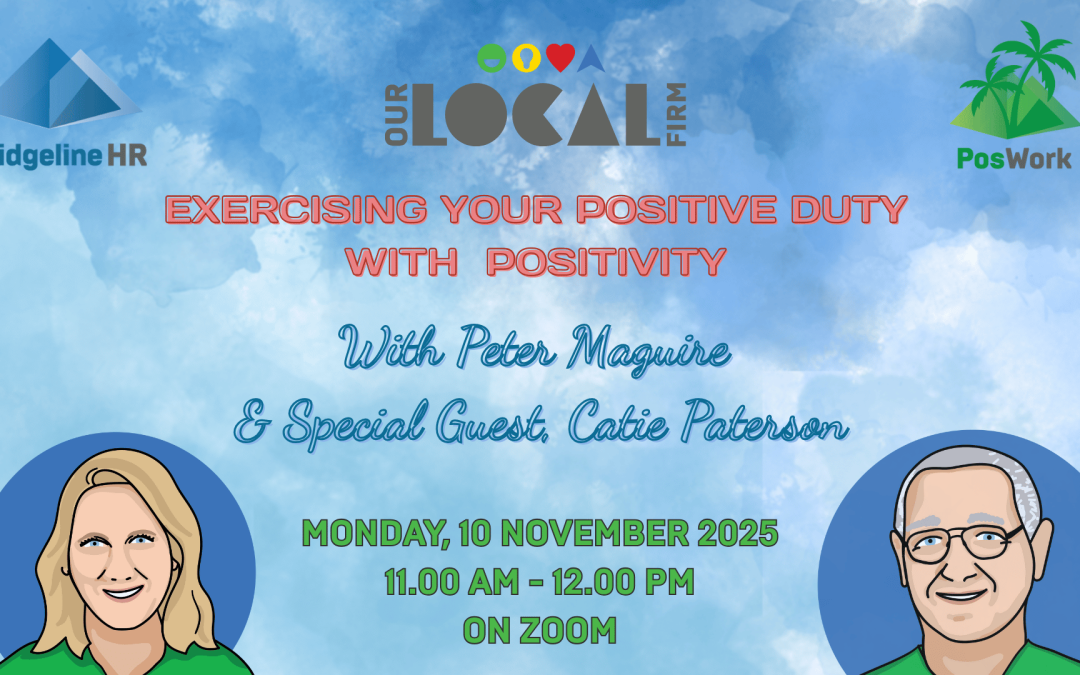
Webinar: Exercising Your Positive Duty With Positivity

Webinar: Exercising Your Positive Duty With Positivity

Blogs and Stories

Webinar: Exercising Your Positive Duty With Positivity

meeting

ABOUT

From 1 December 2025, all Victorian businesses have a new positive duty to eliminate or reduce psychosocial hazards and that involves a lot more than just doing a risk assessment and updating your policies. It also provides a great opportunity for business leaders and HR and WHS professionals to generate real and lasting cultural change with strong employee engagement and psychological safety. Peter Maguire, Practice Leader at Ridgeline HR and PosWork will be discussing this with Catie Paterson from Blue Kite Consulting. They share decades of experience in the HR field and are experts in workplace relations and related compliance as well as in positive psychology based workplace cultures and change management. When you blend all of that together, you’ll get much more than the same old risk management spiel on psychosocial hazards and they’ll teach you how to address the positive duty with positivity using a strengths-based approach with some practical exercises to boot.

DATE

Monday 10 November 2025 11:00 AM – Tuesday 11 November 2025 12:00 PM (UTC+11)

Bookings at https://www.trybooking.com/DGREZ

CONTACT US

PosWork

A Division of Ridgeline Human Resources Pty Ltd
ABN : 24 091 644 094

info@poswork.com.au

0438 533 311

LET'S HAVE A CHAT

The power of positive reflection

The power of positive reflection

Blogs and Stories

The power of positive reflection

meeting

Have you heard any workplace culture gurus say that you can only learn from your mistakes? We disagree. While analysing what went wrong has its place, constantly focusing on deficits can be draining and demotivating. What if we flipped the script? Enter strengths-based reflective practice, a powerful approach that builds you up by focusing on what you do best.

What is Strengths-Based Reflection?

Instead of starting with “What did I mess up?” strengths-based reflection asks, “What went well, and why?” It’s a purposeful process of identifying your successes, no matter how small, and exploring the specific skills and personal qualities you used to achieve them. It’s not about ignoring challenges; it’s about approaching them from a position of competence and resourcefulness. Think of it as building on a solid foundation rather than just patching up cracks. By understanding the ingredients of your success, you create a recipe you can use again and again.

Learning and Improving Through Strengths

Focusing on your strengths is a game-changer for professional and personal growth. It builds confidence and motivation, reminding you of what you’re capable of. This positive reinforcement creates a powerful feedback loop that energizes you to take on new challenges.

So, how do you turn this reflection into action?

  1. Pinpoint a Success: Think of a recent situation where you felt effective or proud. It could be skillfully de-escalating a tense meeting, finishing a complex task, or offering a colleague the perfect piece of advice.
  2. Analyze Your Strengths: Ask yourself:
    • What specific skills did I use? (e.g., clear communication, critical thinking, empathy, organization).
    • What personal qualities helped me? (e.g., patience, creativity, determination).
    • What conditions allowed me to succeed? (e.g., good preparation, a supportive environment).
  3. Frame Improvement Actions Positively: Now, look forward. Instead of thinking, “I need to be less disorganised,” try framing it as, “How can I use my strength for creative problem-solving to set up a better organizational system?” or “Given my success in communicating clearly on that project, how can I apply that same skill to my weekly team updates?” This approach turns improvement into an act of leveraging your talents rather than fixing your flaws.

But what about those that didn’t go to plan

You can use the same approach but you can add in an ingredient which is about whether there was a character strength overplayed or underplayed – for example, ask “Was I too creative in my approach and did I need to show more perspective?” or “Did I misread them and do I need to support my social intelligence with better research before engaging with them again?”

The Secret Ingredient: Self-Compassion ❤️

This entire process is underpinned by self-compassion. It’s about treating yourself with the same kindness and understanding you would offer a friend. We all have moments where we fall short. When reflecting on a tougher situation, avoid harsh self-judgment.

Acknowledge the difficulty with curiosity, not criticism. Ask, “That was challenging. What strength could I have leaned on more?” or “What can I learn from this experience for next time?” Self-compassion allows you to learn from the full spectrum of your experiences without the baggage of shame or burnout. It’s the safety net that makes honest reflection possible, ensuring that your journey of growth is sustainable and, most importantly, kind.

And then. give yourself a little reward for having the courage to engage in honest but self-compassionate reflective practice.

If you would like to explore ways that we can help you to build reflective practice or with any other of our PosWork programs for your workplace, please call us on 0438 533 311 or email info@poswork.com.au.

CONTACT US

PosWork

A Division of Ridgeline Human Resources Pty Ltd
ABN : 24 091 644 094

info@poswork.com.au

0438 533 311

LET'S HAVE A CHAT

How a strengths mindset tops a risk management mindset

How a strengths mindset tops a risk management mindset

Blogs and Stories

How a strengths mindset tops a risk management mindset

meeting
With the advent of the new positive duties, is it really effective to address the prevention of sexual harassment and gender-based behaviours and the elimination or control of psychosocial hazards with the same old risk management and control process that the regulators have chosen? We know there is a much better way.

For years, organisations have tackled psychosocial hazards like stress, burnout, and poor workplace culture using a traditional risk management model. It’s a familiar process: identify the problem, assess the risk, and implement a control. While well-intentioned and often required by regulators, this “find-and-fix” approach can feel like a compliance-driven game of whack-a-mole. It focuses entirely on what’s wrong, often creating a culture of blame-avoidance rather than genuine wellbeing.

That’s why we went looking for better ways to help organisations and people build psychologically and psychosocially safe workplaces.

We asked: “What if we flipped the script? What if, instead of hunting for hazards, we started searching for what gives our workplace life?” Here is what we came up with.

It is the power of combining Appreciative Inquiry (AI) with the PERMAH model of wellbeing. It’s a proactive, human-centric approach that doesn’t just prevent harm – it actively cultivates a thriving work environment.

The Old Model vs. The New Mindset

The traditional risk management model is inherently deficit-based. It asks questions like:

  • “What’s causing stress?”
  • “Why is communication failing?”
  • “How do we stop bullying?”

This line of questioning puts teams on the defensive and focuses energy on problems.

In contrast, Appreciative Inquiry is a strengths-based methodology. It operates on the simple premise that organisations move in the direction of the questions they ask. AI seeks to understand and amplify the “positive core”—the best of what is and what has been.

This is where the PERMAH model provides the perfect framework. Based on the ground breaking wellbeing theory of Professor Martin Seligman, it sets out six core pillars of flourishing:

  • Positive Emotion : Experiencing joy, hope, and optimism.
  • Engagement : Being fully absorbed and in “flow” with your work.
  • Relationships : Having strong, supportive connections with others.
  • Meaning: Feeling connected to a purpose greater than oneself.
  • Accomplishment: A sense of achievement and mastery.
  • Health: Physical wellbeing through sleep, nutrition, and movement.

How the Partnership Works in Practice

Instead of using a checklist to find deficits, you use AI to explore moments of peak performance through the lens of PERMAH. The questions change dramatically:

Traditional Hazard Focus Appreciative Inquiry + PERMAH Approach
“Why is team morale so low?” (Relationships) Tell me about a time this team collaborated brilliantly. What made that success possible?”
“What are the biggest stressors?” (Engagement) Describe a project where you felt completely energised and in flow. What were you doing?”
“Why do people feel unappreciated?” (Accomplishment) Think of a moment you felt incredibly proud of your work here. What conditions allowed that to happen?”

This process doesn’t ignore problems. Instead, it uncovers the root causes of success and wellbeing. By discovering what works, teams can consciously design and create more of those conditions, embedding them into their culture. You identify the ingredients of a great day at work and find ways to make them happen more often.

Why This Approach Is More Effective

There are a host of reasons why adopting a strengths-based approach produces better outcomes because it:

  1. Builds Psychological Safety: Focusing on strengths and successes creates a safe environment for open dialogue. People are more willing to contribute when the goal is to build on positives rather than assign blame for negatives.
  2. Generates Ownership & Energy: AI is a deeply collaborative process. It invites everyone to co-create a better workplace, leading to greater buy-in and a genuine desire to implement change. The process itself is energising and builds morale because people are part of it.
  3. Creates Proactive & Lasting Change: A traditional model reacts to problems. This approach proactively builds the foundations of a positive culture. A workplace rich in PERMAH is naturally more resilient to psychosocial hazards. It’s the difference between constantly patching a leaky boat and building a stronger, more buoyant one from the start.

By shifting from a deficit-based mindset to one of appreciation and potential, we move beyond mere compliance. We start building workplaces where people don’t just survive—they truly thrive.

If you would like to explore how we can help you to change the game in your workplace with your own BETTER Workplace Team or with any other of our PosWork programs for your workplace, please call us on 0438 533 311 or email info@poswork.com.au.

CONTACT US

PosWork

A Division of Ridgeline Human Resources Pty Ltd
ABN : 24 091 644 094

info@poswork.com.au

0438 533 311

LET'S HAVE A CHAT